




ORGANS OF PARIS © 2026 Vincent Hildebrandt HOME ALL ORGANS



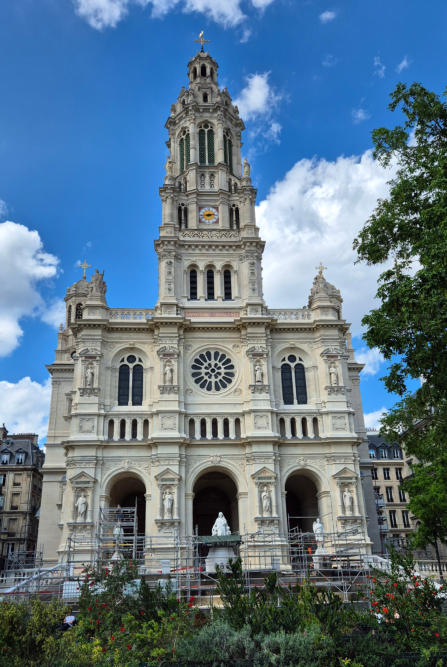
The church of the Trinité was built between 1861 and
1867 by Théodore Ballu, in a Renaissance style blended
with the characteristics of the Second Empire style.
An earlier church of the Trinité, made of polychrome
wood, had been built in 1852 on rue de Clichy. Its
relocation a few hundred metres further down, to the
site of the Cabaret de la Grande Pinte, was decided by
Baron Haussmann as part of the transformations of
Paris carried out under the Second Empire on the
orders of Emperor Napoléon III. The church was placed
at the end of the vista opened up by the rue de la
Chaussée‑d’Antin. The need to raise it slightly to follow
the beginning of the slope of the Montmartre hill
further enhances the monumentality of the building,
which stands after a small square. Work began in 1861
and was completed in 1867, with Théodore Ballu as the
architect. Designed to be seen from the Paris Opéra,
the church was considered remarkably economical
despite the luxury of its decorations: Baron Haussmann
himself indicated that it had cost 3.2 million francs. The
building nevertheless remains impressive, at 90 metres
in length, 34 metres in width, 30 metres in height, with
a bell tower rising to 65 metres.
The funerals of Gioachino Rossini, Hector Berlioz,
Georges Bizet, and Nadia Boulanger were celebrated
there. Among its notable parishioners were the De
Wendel family, as well as Lily and Nadia Boulanger.
The parish of the Trinité, consecrated in 1913, was the
first in France to be entrusted to the Emmanuel
Community by Mgr Lustiger in 1986, so that it could
animate the whole pastoral service there.

C3
1884-1869
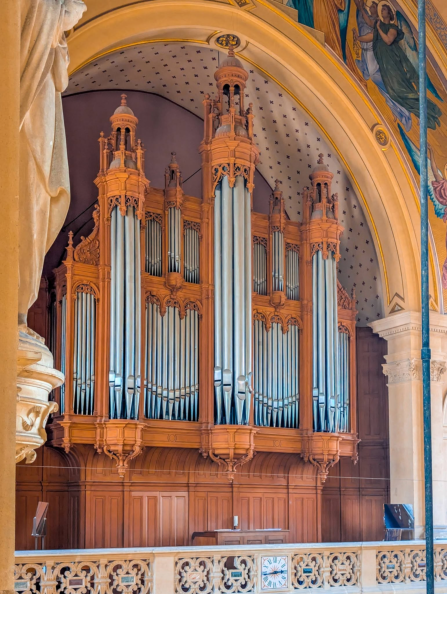
The great organ is one of Cavaillé-Coll's major works.
Commissioned in 1864, it was inaugurated in 1869 by
Camille Saint-Saëns, César Franck, Alexis Chauvet (the first
titulaire), Henri Fissot and Charles-Marie Widor.
1871
The instrument. being considerably deteriorated during
the events of the Commune, was completely rebuilt in
1871 by Cavaillé-Coll. The organ had 46 stops on 3
keyboards and pedalboard. Apart from the replacement of
the Doublette 2' by the Quinte 2 2/3', the organ will remain
so until 1901.
1901
Mutin or Merklin made several modifications.
1934-1935
A major restoration was carried out by Pleyel-Cavaillé-Coll
including
•
a complete restoration of the mechanics
•
dusting of the pipes
•
revoicing of old stops
•
addition of seven new stops
POS: Principal 8', Cor de nuit 8', Nasard 2 2/3', Tierce 1
3/5;
REC: Bourdon 16', Nasard 2 2/3, Cymbalee III),
•
addition of two combination pedals (introduction of the
Pedal, low octave on the Great Organ)
•
removal of the 4' Flutes from the reed windchest and
their installation on that of the foundation stops
•
addition of Barker levers to the Positive.
The organ now has 53 stops.
1962-1967
Beuchet-Debierre carried out a third restoration and
enlargement. The program of work included
•
complete electrification of the organ
•
the installation of a new console (the old one was
dismantled and destroyed)
•
additional upper boards to the GO and Positive
•
appearance of a combinator with adjustable
combinations
•
appearance of an expressive box to the Positive for the
Cornet (decomposed) + Piccolo and Clarinet
•
addition of 7 stops:
POS: Clairon 4', Flageolet 2', Fourniture IV;
REC: Bombarde 16', Tierce 1 3/5'; GO: Cymbalee IV;
PED: Plein Jeu IV.
According to correspondence between Messiaen and Eugène
Picaud (one of Beuchet's employees), Messiaen insisted that
the stamps of Cavaillé-Coll remain unchanged.
The organ now has 60 stops.
1984
Sebire & Glandaz carried out some work. Olivier Messiaen
asks that some background stops have a greater sound
presence by increasing the intensity gradually towards the
treble. Some reeds will also be increased in intensity and
strength. Some teeth are reduced so that the whole is less
"gambé" and that the attack of the notes is particularly
clear and that the voicinggives each stop a very specific
luminosity. The highest pipes of the Piccolo are replaced by
pipes of larger size.
1992-1993
Sebire & Glandaz carried out a complete overhaul of the
organ. Olivier Messiaen wants the Cymbale of the Great
Organ to be reduced. At his request, the fourth row is
blocked on the entire extent of the keyboard except the
last five notes and the third rank is also blocked on the
large expanse of the keyboard (ut1 – sol3). In addition, the
work includes:
•
All the pipes are removed, inspected, cleaned, and
adjusted
•
Almost all of the pipe leadings are replaced.
•
The console is rewired.
•
The note and stop actions are overhauled.
•
A complete cleaning is carried out.
•
The organ is re‑voiced and given a full tuning.
The total number of stops increased to 61 after the
1962–1967 enlargement (+ GO Doublette 2’).
In 2004, overhaul by Olivier Glandaz.
An interesting detail to note: this organ has no case, only a
façade. The instrument itself stands behind it, directly on the
stone floor!

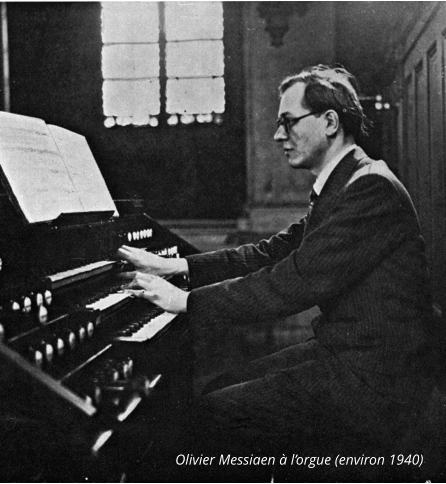


Titular organist
Thomas Lacôte (titulaire), Jean-François Hatton (titulaire
adjoint), Loïc Mallié (titulaire honoraire)
Organistes célèbres ayants illustré l’orgue par le passé :
Charles-Alexis Chauvet, Alexandre Guilmant, Olivier
Messiaen, Naji Hakim
Parish website
Videos
Thomas Lacôte
Karol Mossakowski
photo
Case: Jeroen de Haan
Eglise: Vincent Hildebrandt
1868 - Cavaillé-Coll (1)
1871 - Cavaillé-Coll (5)
1901 - Mutin ou Merklin (5)
1935 - Pleyel-Cavaillé-Coll (3a)
1967 - Beuchet-Debierre (3a)
1984 - Sebire & Glandaz (6)
1993 - Sebire & Glandaz (5)
2004 - Glandaz (6)
III/61 - electrical traction
Stoplist








The organs of Paris


ORGANS OF PARIS © 2026 Vincent Hildebrandt

C3
1884-1869
The great organ is one of Cavaillé-Coll's major works.
Commissioned in 1864, it was inaugurated in 1869 by Camille
Saint-Saëns, César Franck, Alexis Chauvet (the first titulaire),
Henri Fissot and Charles-Marie Widor.
1871
The instrument. being considerably deteriorated during the
events of the Commune, was completely rebuilt in 1871 by
Cavaillé-Coll. The organ had 46 stops on 3 keyboards and
pedalboard. Apart from the replacement of the Doublette 2'
by the Quinte 2 2/3', the organ will remain so until 1901.
1901
Mutin or Merklin made several modifications.
1934-1935
A major restoration was carried out by Pleyel-Cavaillé-Coll
including
•
a complete restoration of the mechanics
•
dusting of the pipes
•
revoicing of old stops
•
addition of seven new stops
POS: Principal 8', Cor de nuit 8', Nasard 2 2/3', Tierce 1
3/5;
REC: Bourdon 16', Nasard 2 2/3, Cymbalee III),
•
addition of two combination pedals (introduction of the
Pedal, low octave on the Great Organ)
•
removal of the 4' Flutes from the reed windchest and
their installation on that of the foundation stops
•
addition of Barker levers to the Positive.
The organ now has 53 stops.
1962-1967
Beuchet-Debierre carried out a third restoration and
enlargement. The program of work included
•
complete electrification of the organ
•
the installation of a new console (the old one was
dismantled and destroyed)
•
additional upper boards to the GO and Positive
•
appearance of a combinator with adjustable
combinations
•
appearance of an expressive box to the Positive for the
Cornet (decomposed) + Piccolo and Clarinet
•
addition of 7 stops:
POS: Clairon 4', Flageolet 2', Fourniture IV;
REC: Bombarde 16', Tierce 1 3/5'; GO: Cymbalee IV;
PED: Plein Jeu IV.
According to correspondence between Messiaen and Eugène
Picaud (one of Beuchet's employees), Messiaen insisted that the
stamps of Cavaillé-Coll remain unchanged.
The organ now has 60 stops.
1984
Sebire & Glandaz carried out some work. Olivier Messiaen
asks that some background stops have a greater sound
presence by increasing the intensity gradually towards the
treble. Some reeds will also be increased in intensity and
strength. Some teeth are reduced so that the whole is less
"gambé" and that the attack of the notes is particularly clear
and that the voicinggives each stop a very specific luminosity.
The highest pipes of the Piccolo are replaced by pipes of
larger size.
1992-1993
Sebire & Glandaz carried out a complete overhaul of the
organ. Olivier Messiaen wants the Cymbale of the Great
Organ to be reduced. At his request, the fourth row is
blocked on the entire extent of the keyboard except the last
five notes and the third rank is also blocked on the large
expanse of the keyboard (ut1 – sol3). In addition, the work
includes:
•
All the pipes are removed, inspected, cleaned, and
adjusted
•
Almost all of the pipe leadings are replaced.
•
The console is rewired.
•
The note and stop actions are overhauled.
•
A complete cleaning is carried out.
•
The organ is re‑voiced and given a full tuning.
The total number of stops increased to 61 after the
1962–1967 enlargement (+ GO Doublette 2’).
In 2004, overhaul by Olivier Glandaz.
An interesting detail to note: this organ has no case, only a
façade. The instrument itself stands behind it, directly on the
stone floor!

Titular organist
Thomas Lacôte (titulaire), Jean-François Hatton (titulaire
adjoint), Loïc Mallié (titulaire honoraire)
Organistes célèbres ayants illustré l’orgue par le passé :
Charles-Alexis Chauvet, Alexandre Guilmant, Olivier Messiaen,
Naji Hakim
Parish website
Videos
Thomas Lacôte
Karol Mossakowski
photo
Case: Jeroen de Haan
Eglise: Vincent Hildebrandt
1868 - Cavaillé-Coll (1)
1871 - Cavaillé-Coll (5)
1901 - Mutin ou Merklin (5)
1935 - Pleyel-Cavaillé-Coll (3a)
1967 - Beuchet-Debierre (3a)
1984 - Sebire & Glandaz (6)
1993 - Sebire & Glandaz (5)
2004 - Glandaz (6)
III/61 - electrical traction
Stoplist

